Showing posts with label Healthy Tips. Show all posts

Thursday, October 18, 2012

Costco Trip & Frozen Burger Prep

Here's my latest Costco trip:
Organic Frozen Broccoli 4 lb $6.49
Organic Apple Slices 3 lb $8.99
Organic Frozen Blueberries 3 lb $11.59
Organic Diced Tomatoes (8) 14.5 oz cans $5.99
Organic Tomato Paste (12) 6 oz cans $5.99
Sea Salt 30 oz $2.79
Avocados 6ct $4.79
Ground Beef @ $2.99/lb = $17.07
Bacon (2) 4 lbs @ $11.99 each
Total $88.56

I rather save my good pink salt for cooking, so I picked up this white sea salt just for soaking almonds and nuts.

I save my good, lean grass-fed beef for casseroles and meatloaves, and use this regular beef for burgers. I prefer the taste of this meat for my burgers, and I think the extra fat makes it a better burger. I do drain and toss the fat. I like to make patties and freeze this meat so we can quickly throw a couple burgers on the foreman when we want. I use a 1/2 measuring cup to scoop and form the patties, place on parchment paper cut into squares, mash with my hand to desired shape, stack into an old bread bag, tie up, and freeze. Last batch of these really got smooshed at the bottom, so here's what I did this time:
I stacked my 17 patties on a baking sheet in 4 smaller stacks and put directly into my freezer. I totally forgot about them for 4 hours, and they were frozen when I checked on them. They were super easy to stack right  into the bread bag and tie up. I think these taste better than pre-formed patties, and it's also cheaper!

Tuesday, October 16, 2012

A Week of Fall Eating

Fall is my absolute favorite time of year. We have been decorating for Halloween, making leaf traces,  slow-cooking lots of bone broth, and embracing new fall foods like apples, sweet potatoes, and butternut squash.

This time last year, I wasn't allowing myself any of these wonderful foods because I was still in fat-loss mode and avoiding starches. This year, I am LOVING them! There is a lot of debate over whether potatoes are "Paleo" or not, so that's another reason I try to avoid that label and just say, "We are eating clean, whole foods." In my experience, (and this seems to be true for a lot of people as well), starchy foods may best be avoided while trying to lose fat. However, I do think that it should only be temporary. I believe that going too low-carb, for an extended period of time, may not be such a good thing since you could be missing some of the valuable nutrients in the higher-carb (yet still whole) foods like potatoes and certain fruits. So once you've reached your health goals, I say re-introduce some of these unprocessed foods, one at a time, and see how your body responds. If your body responds negatively (like getting sleepy after eating them, or having to run to the bathroom), then maybe that particular food isn't for you. I cook our potatoes, regular and sweet, with lots of fat, which helps stabilize blood sugar. I also add cinnamon (another blood sugar stabilizer), almond butter, or coconut oil to my fruits, especially bananas and apples. This works for me. You may have to play around with a few things to find what works for you. We all tolerate foods differently.

Over the past few weeks, I've been playing around with a few new dishes, but mostly I've been making a lot of our usual meals like meatloaf and eggplant lasagna. I decided to try and keep up with our meals for a week and share what our meals usually consist of. I took a few pictures when I remembered to do so. Keep in mind that we are eating more of the starchy stuff now than we have since this journey began a year and a half ago. That's also sort of the way it goes when eating what's in season.

Breakfast:
Bacon and eggs with a side veggie like green beans, zucchini, or leftover Brussels Sprouts
About twice a week, we'll all have fried potato rounds
Coffee with coconut oil, pumpkin pie spice, and coconut milk
Kids also have a small piece of sprouted grain toast and fresh fruit

Lunch:
Mini eggplant pizzas with pepperoni, olives, and banana peppers
Avocado salad with cukes, tomatoes, and banana peppers
Leftover chicken liver
Canned sardines in olive oil
Salad
Butternut squash lightly boiled, then sauteed in coconut oil. One batch was cinnamon, one salt & pepper, and one chili powder, salt & pepper. Cinnamon was voted favorite.
Leftover spaghetti

Afternoon snacks:
Lamb bone broth
Almonds
Kids have fruit or veggie with protein, like "Ants on a Log"

Supper:
Homemade fish sticks, sweet potato rounds, fried green beans
Salmon and Zucchini baked in parchment paper, mustard greens
Spaghetti and meatballs served over zucchini noodles with roasted potatoes and onions
Butternut squash soup with burgers

Dessert:
Frozen strawberries and pineapple with almond milk, topped with banana and kiwi slices
Owl Desserts with apple, almond butter, cinnamon, banana, raisins, and almond
Frozen blueberries with coconut milk poured over
Fresh fruit with cinnamon and almonds
Fruit salad with homemade mayo and pecans


Bedtime snack:

Bone broth
Almonds
Coconut oil
Apple with cinnamon
Burger (when I'm really hungry)

Friday, September 14, 2012

CSA Basket & Healthy Shopping Tips

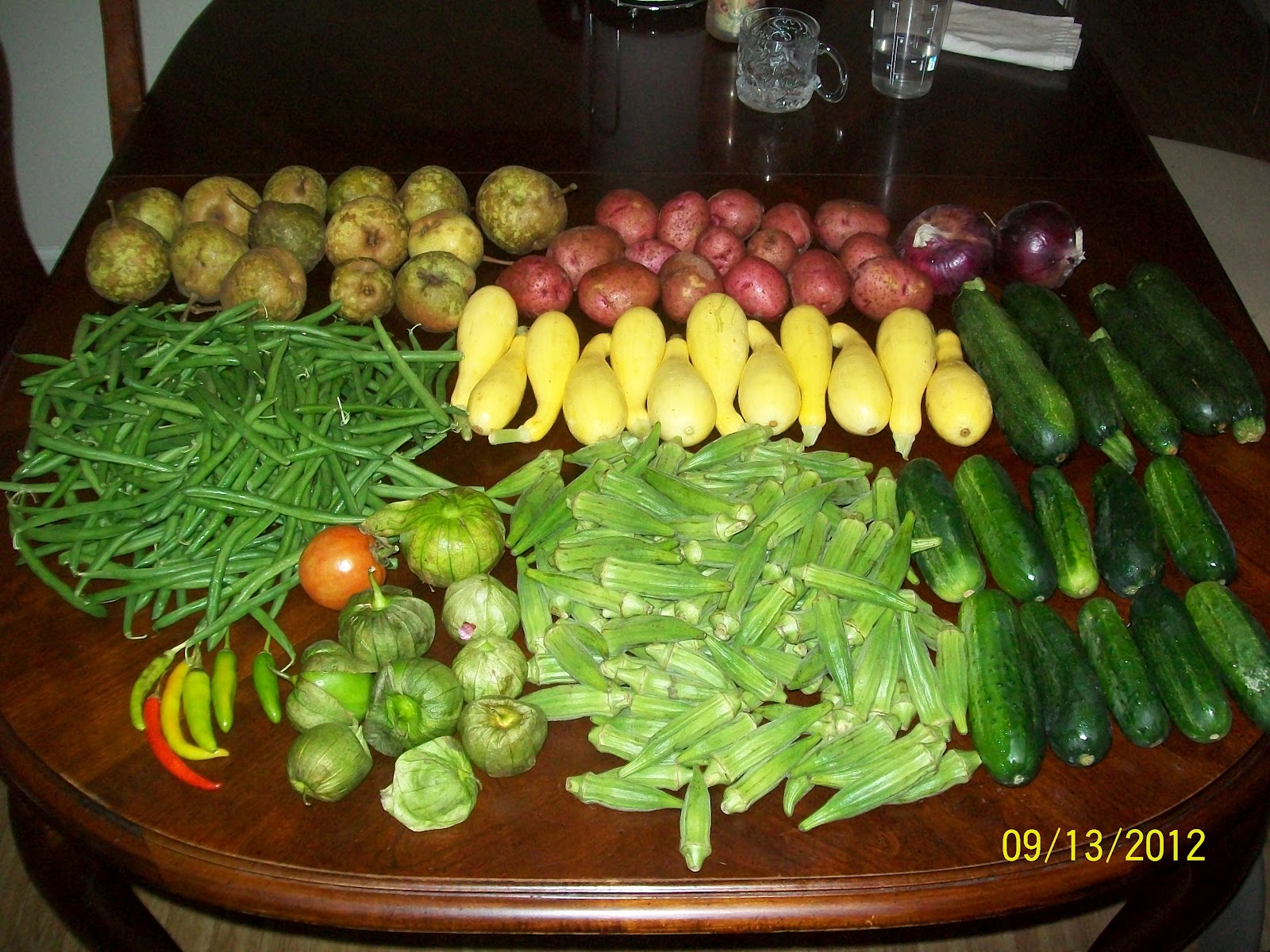
If you are looking for a way to get fresh, local foods into your diet, then check out Community Supported Agriculture (CSA). For more information, or to find a participating farm in your area, enter your zipcode on the localharvest.org/csa website. We feel very fortunate to have found Sugarfoot Organic Farms. The produce is exceptional! We chose a large vegetable share and a small fruit share for $41.95 per week. For ultra-fresh, organic, and local produce, I think that's a bargain! This large share meets most of our produce needs for the week.  This week's basket includes: pears, potatoes, red onion, green beans, squash, zucchini, peppers, tomato, tomatillos, okra, and cucumbers.


Here are some shopping tips that help us make healthy food choices in our home:

1) Choose local foods through CSA programs, farmers markets, and produce stands. These are freshest and often cheaper. This also helps us eat in season.

2) Buy organic when possible. Avoid conventional Dirty Dozen foods like apples, berries, greens, celery, and potatoes (buy these organic since they are highest in pesticide residues). Clean 15 foods are the least contaminated crops, and so buying these conventionally will save you some money on things like avocado, pineapples, mushrooms, and asparagus. I keep both lists on an index card in my purse for easy reference.

3) Shop the perimeter of the grocery store for fresh and whole foods: plants and animals. My personal exceptions include coffee, mustard, spices, almond butter, nuts, tomatoes, olives, canned fish, and coconut milk.

4) Frozen produce and meats are also a good option.

5) Read labels on everything! Avoid the unpronounceable ingredients. Avoid added sweeteners and preservatives. Avoid engineered fats like soybean, canola, corn, and vegetable oils. Look for simple and minimal ingredients.

6) Choose wild fish, whether fresh, frozen, or canned. Avoid farm-raised fish, with the exception of shellfish.

7) Buy in bulk. I buy raw almonds at Costco, traditionally prepare them in batches, and store the rest in the refrigerator. I also buy coconut oil and almond meal online. I buy our grass-fed beef by the 1/8-1/4 cow, and by doing this as a meat share from a local farmer, I don't need a whole lot of freezer space. You could also go in on large purchases with family or friends to split costs.

8) Make sure to cover the basics needed for a complete meal: Veggie, Meat, and Fat.

Do you have any additional tips to share?

Tuesday, September 4, 2012

CSA pickup

Here's our latest CSA basket from Sugarfoot Organic Farms. This week, our small fruit share was more delicious muscadine grapes. Our large vegetable share included tomatillos, jalapenos, cucumbers, purple potatoes, eggplant, sweet bell peppers, squash, zucchini, and green beans. I was glad to see sweet peppers today; they were super crisp and delicious! Our shares come out $41.95 per week. I think that's a great deal for super-fresh organic produce! Here are a few plans of mine for preparing these items this week:

Muscadine grapes: Eat raw, the whole thing. Most of the antioxidants are in the skins and seeds.
Tomatillos: (already gone) Keith charred most of them, chopped and blended, and cooked them down along with 2 lbs of beef for a refreshing beef stew dinner. The rest were blended and added to some store-bought salsa for yesterday's taco salads.
Jalapenos: These have been placed in the fridge, along with banana peppers from previous baskets, in vinegar. They are hot! If anyone has ideas for them, please let me know!
Cucumbers: (already gone) I sliced and refrigerated for easy snacks and salads.
Purple Potatoes: I usually spread these throughout the week, probably two batches of homemade potato chips and a batch of hash browns. These don't seem to bother any of us (starch-wise) when we eat with plenty of fat.
Eggplant: I'll probably spread these into 2-3 different meals as well: either grilled/baked/sauteed with coconut oil, an Italian-style meal like lasagna or spaghetti, or peeled and sliced for mini pizzas.
Bell Peppers: (gone) I chopped the green pepper into quarters and topped with chicken salad for an easy lunch. The girls loved their "boats". The yellow was chopped and added to salad.
Squash: I love these roasted and have been adding them to our breakfasts and/or lunches: cut off ends, slice lengthwise, brush with melted coconut oil, pepper, bake 450° for 20 minutes, flipping halfway through, and salted afterwards. We all seem to enjoy these more as larger cuts, maybe because each side gets nice and brown. The coconut oil gives them a buttery taste, yum!
Zucchini: I'll probably roast this with the squash, unless Keith eats it raw first.
Green Beans: We enjoy these two ways: raw and baked. I went ahead and washed and snapped the ends on the first day, storing them in a ziploc bag with paper towel and in the fridge. We alternate between the raw and roasted, whatever we have time for or are in the mood for. I roast these pretty much the same way: brushed with coconut oil, s&p, 450° but for only 15 minutes, tossing every 5 minutes til done. I've also been adding these to our breakfasts.

I am finding more and more that I enjoy vegetables added to my first meal of the day. The girls and I are satisfied for longer and do less snacking throughout the day. This is one of my breakfasts from last week. It includes my usual bacon and eggs, but on this morning I added leftover grilled eggplant and leftover steamed okra and tomatoes on top, side of avocado. It was quite wonderful! So each day I've been adding some type of vegetables in the a.m., whether it's roasted squash or green beans, raw green beans, or leftover veggies from the night before. I feel better knowing the girls and I are getting more vegetables in our day.

Tuesday, August 21, 2012

CSA Basket & Prepping Tips


This is Saturday's CSA pickup from Sugarfoot Organic Farms. We got okra, peppers, tomatoes, purple potatoes, summer squash, green beans, zucchini, cucumbers, and eggplant. Fruit Share was Muscadine Grapes. I really am glad we went with the large share this time. We get double the produce as the previous share, and added a small fruit share, for only half more in cost. This means we don't have to buy much from the store at the end of the week, maybe some greens and a little fruit. It does take some extra work to stay on top of all this each week, but we're getting pretty good at getting it all gone and/or put away within the week. We usually eat everything from each basket within the week. We have only frozen 1 batch of green beans and 2 batches of peaches so far. A few things that help me stay on top of the produce are:
  1. Try to prep and put away all the produce the first day. Wash all the washable items like squash, zucchini, eggplant, green beans, and cucumbers. Dry and store in a dish pan lined with paper towels, and slip right into the fridge. This makes it easy when I have everything in one place, so nothing gets lost or spoils. Veggies seem to last longer in cool, dark places. When it's time to make supper, I pull out the whole pan and look to see which are softest, and that's what we have for supper.
  2. Prepare snacks. Snap the ends off the green beans, slice cucumbers and peppers, and store in separate containers in the fridge. This saves us time when we need snacks or when making a quick salad for lunch. If it tastes good raw, eat in raw. It's healthier and saves time by not having to cook it.
  3. Some items, like tomatoes, go unwashed til we need them and stay on the counter. I save and reuse containers from store-bought produce. These come in handy on produce day. I put the fruits in them and leave along the counter near the sink and chopping board. Again, they are right in my face and don't get lost or spoiled.
  4. Potatoes and onions usually go straight into my hanging basket. I wash when ready to use them. They seem to last the longest, so I put them off a little later.
  5. Eat from home. I know that's a given, but sometimes when we are out and about on the weekend, and the thought of picking up something to eat creeps into my mind, I quickly remember I have a fridge full of fresh food at home that needs to be eaten before it goes bad. It works! It also helps to have quick protein sources to pair with them, liked canned fish or almonds. We can throw together a quick salad in no time. 
  6. Freeze anything we can't use within the week. Since we get the large shares, even taking one day off in the kitchen can put us behind. If I know we have a family get-together coming up, I try to plan ahead by freezing something easy like green beans or fruit. By doing that right away, we're also freezing while it's fresh. It'll be healthy and tasty.
Do y'all have any tips to share?

Monday, August 6, 2012

Before & After #2

I thought it was time for another Before & After post. Here's more of my story. This is a much clearer picture of how I looked before I started, what I believe to be, the RIGHT path for me and my family. I'm not going to write this is how I looked before I started my "diet", because 1) I'm not on a diet, this is truly a lifestyle for me, and 2) I'd done plenty of dieting by this point. In fact, this is how I looked at 203 pounds after months ON a low-fat/high grain diet, with lots of vegetables. I was always hungry and very tired! I struggled and pushed very hard, every day, to get 20 minutes of walking on the treadmill. Some days, I couldn't even make it 10 minutes. I had ZERO energy! I was SO frustrated! I thought I was doing everything right, eating very little fat (I ate very small portions of lean meats, mostly white meats like chicken and turkey, and the few fats I did eat were olive oil and Smart Balance products), LOTS of whole grains, and fruits and veggies. And, a month after this picture (and doing everything "right" by exercising and eating low fat), my cholesterol numbers got worse! My HDL got lower, dropping almost by half, and my trigs doubled. NOT GOOD! The same thing happened to my husband, he gained weight, and his triglycerides got dangerously high! That's where this journey began, scratching our heads, and trying to figure out what in the world we were doing wrong.

We started changing a few things in our diet, and I lost about 9 pounds, but I still didn't think anything was working the way it should. By chance, I stumbled across Dr. Lustig's lecture, which has forever changed the way I think about sugar, and then I came across the movie Fat Head. Both of these just made sense to me. Around May 2011, after some online reading, I began my reduced-carb stage, as I call it, where I kept total carbohydrates under 100 grams per day. We also bought our first CSA share from a local farmer, with lots of fresh produce and a dozen fresh eggs each week. The weight finally started coming off! I started having more energy, so I did a workout here and there, but I never did stick to any routine. I started having enough energy to just get through the day and do what needed to be done: cooking, cleaning, and looking after my little ones. That was huge for me, to be able to get through the day without feeling so run down. At this point, I was still splurging/treating myself to whatever I wanted to eat on the weekends. After four months, however, I realized my weight loss had stalled at 178, after losing 16 additional pounds on my reduced-carb diet.

My next step was going on Atkins on September 5, 2011. And I did this 100%, no more weekend cheating! First month of Atkins, I lost 13.5 lbs. Second month, 8.3 lbs. Third month, 6 lbs. Fourth month, 4.2 lbs. On December 20th, and I was down to 146 lbs! I was so close to my goal. During all of this, the more weight Keith & I loss, and, the better we felt, the more we were empowered to find out WHY all this was happening, when we were eating the "wrong" foods (lots of fat, meats, and of course, produce, but produce had always been a big part of our diets). We read and read as much as we possibly could. We'd compare notes at the end of the day, and we were fascinated with our findings! We found Sean Croxton at Underground Wellness, who pulled everything together for us. We read/listened to a lot of his findings, which went right along with a lot of things we'd already found, plus a whole lot more that we didn't know! The Dark Side of Fat Loss was the first (e-) book that I've bought in my adult life. I believe it was the most important purchase I've made, ever. We learned so much through his book, and again, it just made sense! (If anyone is interested in purchasing his e-book, make sure you become a facebook fan of his and you'll get a discount!) Sean has a gift for explaining things in a way that's easy for all of us to understand. His advice it "Just Eat Real Food!" He explained why we should eat cleanly, and how to do so.

We started making changes to eat and live cleaner, removing toxins from food and personal care products, as well as household items. Through this process, we gradually gave up things like High Fructose Corn Syrup, then sugar, then Splenda; we gave up unhealthy, industrial oils like vegetable, corn, canola, soybean, and butter substitutes; we gave up all grains. In December, I decided to stop counting my carbs and just keep eating whole/real/clean foods. We had just signed up for our new organic CSA share and were so impressed with how good everything tasted. Organic (and especially local, organic) foods are more nutrient-rich and taste so much better! We eat our organic green beans straight from the basket because they taste so good, raw and plain.

Then, Christmas came. I decided to eat whatever I wanted, to "treat myself" for the first time in months. Red velvet cake only comes once a year (and I'd made it!). I was going to have a piece, and so I continued to eat that and anything else I wanted that night, and oh my, did I suffer major consequences! First, I had a terrible headache that I couldn't shake for 3 days! My appetite and body were all out of whack. I had really over done it with the sugar and wheat. It took me 2 weeks to get back to normal.

I've had a few indulgences since then, but I have learned how to have some treats, without overdoing it to the point of suffering later. What seems to work for us,  is to fill up on the good stuff (plenty of protein and some veggies) and then have a small scoop of whatever I want after. Since my body is busy digesting that big piece of meat I just ate, that little bit of sugar doesn't seem to bother me as much. Plus, I just can't eat as much sugar as I once could as my tastes have changed and sugary things are just way too sweet!

So where was I on the timeline? Ah, yes. 2012. I continued on my whole/real/clean, whatever you want to call it, foods. We had new cholesterol tests taken in January, and everything had improved! The biggest indicators from a basic lipid panel are the trigs and ratio, both were great! All numbers had moved into the right direction and then some. I started the year at 144.8 lbs and over the next 6 months, lost 9.8 lbs. Not bad! I'm eating well, not even trying to lose weight, but just be healthy and feel well, and the weight is still coming off? NICE! In July, we gave up pasteurized dairy. Our health has improved even more, and I've lost another 6 lbs in 2 short months! I am now 128.8 lbs, GAH-LEE!

I really am amazed at all the transformations! This all seems so magical to me. I still eat the things I love, making some adjustments, but I eat very well! I am not starving, and I feel great! I met my weight loss goal 3 months ago, and so I am glad that I am no longer stressing to reach that number. I am just giving my body the most nutrient-rich foods I can and striving for better health. I believe my body will decide what my weight should be. As long as I am getting proper nutrition, reducing toxins in my life, working on stress management, and get my butt to a little exercise, I think I'll be okay. I have NEVER seen my body like this. I am finding some of those feminine features on my body for the first time in my life, some I've always wanted to see, but never have. The collar bone, slim fingers, that crease down the side of my upper leg, reduced cellulite, no more back flab, jawbone, and even veins on my feet. I hope this doesn't sound too weird, I guess I'm just trying to say that I haven't seen my body like this, ever, and I love seeing what's been hiding underneath all this weight all these years! I weigh less than I did in high school. I never thought this would be possible. After struggling with weight my whole life, I feel like I finally got it right! I know there is lots more to learn, so I will not stop learning. I think it's good to question what we think we know about health. Be open-minded. Try something new!


Sunday, June 17, 2012

Milk Does a Body Good? Maybe Not!


Although I disagree with his thoughts on grains, I think he hit the nail on the head with the dairy advice. I have done just as he suggested and stopped dairy consumption completely. I am probably going to go 2 weeks to a month without any dairy products to see how it goes. This is not the only place I have seen this information presented. It's striking to me, that the countries with lower dairy consumption have lower rates of osteoporosis. There are some ongoing studies to support that conventional milk may be a culprit in causing Autism. I am not going to get into that with this post, but I would be happy to share some sources for those interested.

 Here I am! This is my 7th day without one single dairy product. I remember how skeptical I was before eliminating grains from my diet. I read about the harmful effects and how great people felt after removing them. I tried it and low and behold, it was true. I noticed a HUGE improvement in my mood, energy levels, and alertness. I am taking the next step and testing to see if I experience similar results after eliminating the dairy. It hasn't been the easiest thing to do either. I miss my pastured butter and heavy cream but it is necessary to see full results. I will slowly add back in one dairy product at a time, to see which ones may be causing issues.

 "Quitting dairy?", I hear you say. It's blasphemy, right? We have been taught for years that dairy is so good for us.  So, fast forward almost a year later after reading and researching the effects of dairy on the human body. Screw what USDA and the "Pyramid" have to say. From everything that I have gathered, the pastured butter and the heavy cream is usually okay. It's the pasteurized and homogenized stuff that tends to create inflammation. This is the same for people who are lactose intolerant. The enzyme, lactase, that is normally in raw or low heat pasteurized milk is damaged in the heating process. It's presence in milk that is not heated to extremely high temperatures, assists in digesting the lactose before it is even ingested. This is why a huge number of individuals, who are lactose intolerant, can drink raw/low pasteurized milk without experiencing the discomfort that they do when consuming the stuff you find at your grocery store. I hear that most is "Ultra" pasteurized milk, and it is heated to 280 °. That kind of temperature kills everything in the milk.

 So you ask, "How do you feel after 7 days without dairy?.  AMAZING!! My energy level is through the roof and not experiencing any knee discomfort as I normally do. I have also noticed that my nose has not been dripping, like a faucet, within the first hour or so upon waking in the morning. More to come later.

6/23/2012: I am 2 weeks now and can't explain how much more energy I have. It is looking bad for dairy thus far.

7/7/2012: I am just a couple of days away from completing my dairy free 30 days. I have noticed a significant difference in allergy issues. The sinus flare ups are nonexistent and I have only taken one Claritin in the last 28 days.

Saturday, June 16, 2012

Fruit Talk

I wanted to make a little post on fruit. We love fruit. It's natural, it's sweet and juicy. But...Keith and I, for the most part, only have a little low-sugared fruit each day. The girls have a little more. Let me explain why we limit ourselves.

Fruit contains sugar (primarily fructose). In nature, fructose is found with fiber. The fiber in whole fruits slows the sugar absorption and eases the load on the liver. This makes fruit easier to consume, but, it can still be stored as fat. Because of agricultural selection, many fruits we consume today have become sweeter than as found in nature...more fructose and less fiber. Fruits weren't always available year round. So it seems our fruit is sweeter and much more readily available than nature intended. I think it's always a good idea to eat in season, whether it's fruit or vegetables.

Fruit juice is not a fruit! I don't care what the label says, whether it's "100% Juice or No Sugar Added", it should say "100% SUGAR!" That's all it is. Fruit-Fiber=Fructose. After removing the fiber, it's just fructose. It's the same as handing your kids pure sugar. Give them whole fruits instead. Why do they remove the fiber? Somewhere along the way, someone figured out that the fiber makes fruit spoil, and by removing the fiber, shelf life is increased.

For those seeking fat loss, I think it's a good idea to limit fruit intake. Some people have found that when they remove fruit, after hitting a fat loss plateau, they begin to lose fat again. The levels of fruit sugar range from very low to very high. I would stick to low sugared fruits as much as possible when trying to lose fat. Always try to eat them whole. Smoothies can also hinder fat loss. If you are not seeking fat loss, then, by all means, have more fruit. Fruit is very healthy with lots of vitamins, minerals, fiber, antioxidants, and much more. I've made a list that I keep on the fridge, showing the various sugar levels in common fruits.

Fruits Lowest in Sugar: Lemon, Lime, Rhubarb, Raspberries, Blackberries, Cranberries


Fruits Low-Med in Sugar: Strawberries, Papaya, Watermelon, Peaches, Nectarines, Blueberries, Cantaloupes, Honeydew Melons, Apples, Guavas, Apricots, Grapefruit


Fruits Fairly High in Sugar: Plums, Oranges, Kiwi, Pears, Pineapple


Fruits Very High in Sugar: Tangerines, Cherries, Grapes, Pomegranates, Mangos, Figs, Bananas, Dried Fruit

I hope this helps shed some light on fruit consumption. While whole fruits are natural, they should be limited in seeking fat loss. My children are not seeking fat loss, of course, so I let them have a bit more. They eat fruit every day, but not all day. We think it's important that they get the bulk of their carbs from vegetables. You can also listen to your body. I have banana on occasion, but if I eat more than 1/4 banana, I get a little sleepy, which tells me I've had too much. Same for Keith. We just feel better when eating less fruit and ones on the lower sugar end. Fruit is dessert and a treat at our house.

Wednesday, June 6, 2012

Good Dark Chocolate

Good, high quality dark chocolate is actually good for you! It's loaded with polyphenols, which has been shown in some studies to lower blood pressure and improve insulin sensitivity. Cocoa butter, which is extracted from the cocoa bean and used in most good dark chocolates, is a great source of healthy fats (mostly monounsaturated and saturated fat, with very little polyunsaturated fat). A good dark chocolate should have a high cocoa, high fat, and low sugar content, and it should also be self-limiting. It will be a little bitter, and that's a sign of a healthy polyphenols level. You probably won't need much, just 1-2 squares. It is still a candy, and shouldn't be over-indulged in. We started with a 70% cocoa bar. It still had too much sugar for our liking, so we went with this one the second time...Green & Black's Organic 85% Dark Chocolate. It is low in sugar (less than 1.5g for 2 squares). I truly don't need or want any more than 2 pcs at a time. I have a little most evenings. I like to just let it melt in my mouth. It's very nice! You could even try a small pc of dark chocolate with a little coconut oil on it. Good stuff! These bars are not inexpensive, but they last us a week or so. I did find some on sale at Walgreens last week, 2 for $4. Eating healthy has never tasted so good!

Friday, May 25, 2012

Low Carb Rant

I wanted to name this entry "low carb" because I think there is a misconception about exactly what we are doing. I know Kathy has stated that our eating focuses around high fat, moderate protein, and low carb. First off, I would like to say that she is correct, but we do not strive or focus on being low carb. It just happens that way because there are only a few carbohydrate-rich foods that I want anymore. Truth be known, after cutting grains and sugars, there aren't many carbohydrate-rich foods left to choose from, except fruits and starchy veggies. I can eat a ton of spinach, mustard greens, kale, romaine lettuce, or any other leafy green and never get close to 100 grams of carbohydrate in a day. Let me also state that 100 grams of carbs is only low when compared to the SAD (Standard American Diet) which is closer to 300+ grams a day. Furthermore, 100 grams is considered very high for a low carb diet like Atkins. I would estimate that my carb count falls somewhere between 50 to 75 grams on an average day.

This is where it becomes hard to explain to anyone what Kat and I are doing. When we try to explain, we get the response, "OH, you are doing the low carb thing?". I do understand the confusion, but it is also a little frustrating. Most people associate low carb diets with Atkins and picture a follower consuming tons of hot dogs, bacon, burgers, all types of fat, fried cheese, pork skins, and little to no veggies. While we do implement the bacon, burgers, healthy fats, and pork skins into our diet, it does not constitute our whole diet.

I would also like to state, and unknown to some, that we do offer ourselves some slack. We give in and have some fried, flour-coated seafood or chicken. We have cheesecake or my sister-in-law's awesome hummingbird cake on occasion. We do realize the importance of enjoying the taste of those foods that we chose to exclude from our normal everyday menu. It also gives you a chance to realize what those excessive carbs and sugar are doing to your body on a daily basis. You feel like absolute crap after one of those meals. I mean, hangover bad. If that doesn't tell you something, then I don't know what does. I think that grain supporters are so hell bent on proving that their diet is right, that they can't see the forest for the trees. They must be right or everything that has been learned is wasted time. Believe me, I am not out to prove anyone wrong. I just think that it's time to re-evaluate what we have been told for so long, because it's not working.

Why is a bowl of pasta better than a bowl of nice, rich, green veggies? What do grains have that my veggies don't? I am gonna pose a question to the naysayers. I shouldn't have to answer your questions on why I do not eat grains. My question to you is, "Why should I eat grains?".  They are a cheap source of calories, and the nutrient contents pales in comparison to veggies. And besides, you are not going to absorb all that is listed on the side of that box of grains because of the phytates. Lectins, which are found in grains and legumes, damage your gut lining, resulting in intestinal permeability and setting the stage for autoimmunity. Can you say arthritis, gout, or one of the many other conditions caused by systemic inflammation, anyone?  I can also make the argument that complex carbs are not as good as advertised either. They still end up as glucose in the blood stream. Although the transformation is slowed a bit by the added fiber content, it makes the transformation to our good friend glucose nevertheless.

Okay, let me set this up. First and foremost, the body sees excess glucose as toxic. Think about that for just a second. The buildup of glucose in the bloodstream is what causes breakdown of tissue in the limbs in diabetics because of the inability to produce enough insulin to push the excess glucose into fat stores for safe keeping. I think almost everyone can think of one person that has had to have an appendage or limb amputated because of this. Yes, the body can use glucose as fuel. Most grain advocates say it's the body's preferred fuel. Here is where I strongly disagree. Your body burns excess glucose first to prevent it from building to levels that are harmful to the body. It then turns the rest to stored fat. What happens when you bombard your body daily with food that is converted to glucose? Obesity, diabetes, and metabolic disorder are just a few things that come to mind. The pancreas is not designed to pump out insulin all day long, but that is exactly what happens with that bagel, biscuit, whole wheat bread, baked chips, juice, soda, sweet tea, HFCS in condiments, rice, and cereal bar that's consumed everyday. When does the body have time to burn off fat? It doesn't. Now we are off to the treadmills to burn off all this extra glucose that could have been avoided in the first place.

I could go on and on about this subject but I would probably bore you all into oblivion. I just wanted to make a point and maybe even spark something in some of you to start digging and research for yourselves. We are depending on the USDA and the food industry to have our well being in mind, but they don't. If that were the case, you wouldn't see "Heart Healthy" on a bottle of canola oil.

Monday, May 14, 2012

My Personal Health Rules

I thought I would share my favorite and general rules for eating at home and overall health. I'm not telling anyone how he/she should eat, just sharing what we strive for since some of you have asked. I call them "rules", but they are merely our guides that we try to adhere to. They are not perfect and are subject to change as we learn more on this journey to better health. If you have any tips, I'd love to hear them! Leave a comment below.

1) We all eat the same. This makes it easier for us to stick to a healthy way of eating since everyone in our house is on the same page and there are no separately cooked meals nor unnecessary temptations. We just don't keep crap in the house. We do splurge on special occasions, like eating out (maybe once a month) or at a family gathering.

2) Eat fresh produce, as much as possible. Local when available. Organic when possible. We do the best with what's available to us. Frozen fruits & veggies are a good choice when fresh isn't available. I always keep a few frozen veggies on hand, and we regularly consume frozen berries. Limit high starch veggies like potatoes, winter squashes, peas, carrots, and beets. Limit high sugared fruits like bananas, pineapples, dried fruits, and oranges, for example.

3) Avoid processed foods, as much as we can. This cuts out a lot of excess carbs and sugars. If it comes in a box or a bag, we probably shouldn't be eating it. Canned foods often contain added preservatives and the cans themselves often contain BPA.

4) Eat clean meats. Local, pastured animals is the best choice for meats and dairy. It is more expensive and may not be available in all areas. Again, do the the best with what's available. When we purchase commercial meats, we usually try to trim/drain the excess fat and supplement with a healthier fat, if we want. My exception to this is bacon fat. If you notice my posted recipes where I cook with pastured beef, I do not drain the fat. For one, there isn't much fat to drain anyway. Two, it is very clean and healthy and therefore a good fat to consume. This brings me to my next section.

5) Eat healthy fats. We eat fats with every meal and snack. For the most part, we try to adhere to the "5 Healthy Fats": butter, coconut oil, animal fats, olive oil, and cod liver oil. We prefer real butter (from pastured cows); organic virgin unrefined coconut oil; animal fats (mostly pastured); and extra virgin olive oil, either uncooked or at most, very low temps. We have not yet added the cod liver oil to our dietary lifestyle, hopefully that's coming soon. Avoid butter substitutes, refined oils, hydrogenated oils, and vegetable oils, including corn, canola, and soybean oils. I think getting the fats right is a critical step to our best health. Don't be afraid of fats because FATS DO NOT MAKE YOU FAT! (Excess carbs do!)

6) Limit sugar intake. We regularly eat whole, fresh and frozen fruits as well as raw, local honey. No artificial or refined sweeteners, and absolutely NO High Fructose Corn Syrup!

7) No grains. Keith & I don't eat any rice, pasta, bread, cereal, oats, or anything made from corn or wheat. We do limit our girls to a small amount, usually with breakfast.

8) Don't count or measure anything. Just eat real food, and nature will take its course. 80% of our body composition is determined by what we eat. Don't rely solely on scales. I haven't lost that many pounds in the past couple months, but I'm pretty sure my body is still changing since my clothes are fitting better.

9) Get plenty of good sleep, every night. I aim for a 10:00 bedtime. Our room is pitch black. Seriously, I can't see my hand in front of my face at night. Even the smallest amounts of light can disrupt melatonin signaling. Sleep deprivation makes you fat.

10) Play more. This is my newest rule, only a couple days old, actually, and one I am really gonna have to work at. But as Mark Sisson says, exercise doesn't have to be a lot of strenuous activity, and it doesn't have to be boring. He pushes hard less than 1.5 hours a week, including sprints, squats, dead-lifts, and other muscle building/toning exercises. The rest of his physical activity is acquired through "playing". I think that's a great way to look at it. Skeptical? Check out his pics at Mark's Daily Apple. He is 58 years old, or more,  and a former long-distance runner. He knows plenty about physical activity. That's one smart (and very fit) dude!

Thursday, May 3, 2012

Dirty Dozen & Clean Fifteen Lists

We should all be trying to minimize our exposure to pesticides for better health. One way to do this is by choosing Certified Organic. Organic produce may not always be an option, so I think it's important for everyone to know which crops are highest in pesticide residues and which are the cleanest, or least contaminated. The Environmental Working Group has put together a shopper's guide with the "Dirty Dozen" and "Clean Fifteen" lists for easy reference. I always keep these lists with me when I shop. If the item is on the Dirty Dozen list, I choose organic or avoid. Apples and celery are currently the two dirtiest foods, and yet they only cost a few cents more to buy organically.

2011 Dirty Dozen (Buy these organic)
1) Apples
2) Celery
3) Strawberries
4) Peaches
5) Spinach
6) Nectarines-Imported
7) Grapes-Imported
8) Sweet Bell Peppers
9) Potatoes
10) Blueberries-Domestic
11) Lettuce
12) Kale/Collard Greens

2011 Clean Fifteen
          1) Onions
          2) Sweet Corn
          3) Pineapples
          4) Avocado
          5) Asparagus
          6) Sweet Peas
          7) Mangoes
          8) Eggplant
          9) Cantaloupe-Domestic
          10) Kiwi
          11) Cabbage
          12) Watermelon
          13) Sweet Potatoes
          14) Grapefruit
          15) Mushrooms

Sunday, April 29, 2012

Before & After #1

Thanks to my sweet sister for the encouragement to post this! Here's my "before" picture. I couldn't find a picture of just me since I shied away from the cameras at this size. This was Thanksgiving 2010. On January 1, 2011, I started a new journey, weighing in at 203 lbs.
This is today. 137 lbs. It's taken me 15 months to get here. That may sound like a long time, but it has passed in a flash! There are still times when I walk by the mirror, stop, and back up...to look again...to see if what I just saw was real. I still can't believe I've lost so much weight! I am at my high school weight, after 2 babies! If I don't lose another pound, I am okay with that. I feel great. I have lots more energy, and I feel so good about myself! And the best part? I haven't starved myself, at all. I eat plenty of food, and the foods taste SOOOO good. So what did I do? I took out the sugars, grains, and trans fats. I stopped eating the cardboard-tasting, sugar-laden, low-fat, and so-called "heart-healthy" foods like bread, pasta, chex mix, cheerios, butter substitutes, skim milk, turkey bacon, turkey sausage, turkey burgers, and yolk-less eggs. I replaced them with things like bacon cheeseburgers with lettuce instead of a bun; steaks; roasts; pork sausage; eggs WITH yolks, fried in butter and a side of bacon; blueberry ice cream; flour-less pizza; full fat cheeses; raw nuts; apple smeared with natural peanut butter, celery smeared with cream cheese; coffee with heavy cream, butter, and coconut oil; fried cheese; pork skins; and VEGGIES! LOTS and LOTS of veggies! Organic when possible, and as many dark, leafy, nutrient-rich vegetables as I can! I have gotten to know many new vegetables, thanks to my CSA shares each week. I have learned to cook, and LOVE, many new things like kale, beets, creasy greens, turnips, winter and summer squashes, different colored onions, eggplant, pumpkin, spinach, and so much more. That's where the swapping took place...we swapped low fat meats for clean meats WITH the fat (where the deliciousness is), swapped refined carbs/starches for fresh and organic vegetables, swapped junk food for nuts and fruits, and swapped low fat dairy for full fat dairy. Hard to believe? It certainly was for us...at first. But, we did our homework! We found what works for us. It is possible to be healthy and eat good foods. That's why I share this stuff...because we've been through the trials and errors, we've tried different things, and we chose this way of eating because it works for us. And if anyone is wondering about our cholesterol and triglyceride numbers? Lol...oh boy! We'll have to start a new post on that! Long story short, though, our numbers got worse on a low fat diet, and better on this way of eating. It's true. That's where Keith & I began this journey, scratching our heads after our tests. We had a lot to learn! And we are still learning. I hope I succeeded in making somebody's mouth water when describing what we get to eat. It is a delicious way to live!